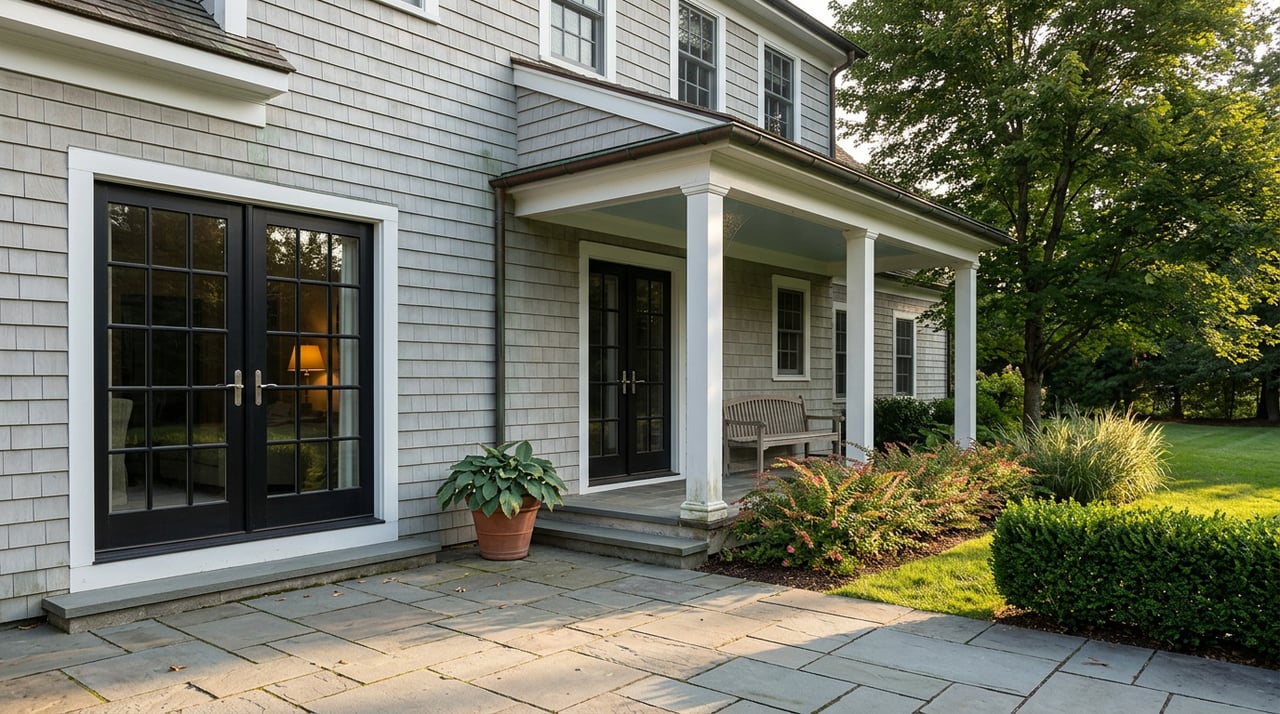
The Real Ceiling on Medway's Housing Supply Isn't Politics. It's a Pipe.
According to the Millis/Medway Local Town Pages, on the night of June 9, the folding chairs at Medway Middle School ran out. The Planning and Economic Development Board had already postponed the hearing once, on May 26, because more people showed up than the original room could hold. This time the town brought in a security detail. Board chair Andy Rodenhiser opened the meeting by telling the standing-room crowd, "we've done this many times in the past but we've never had a project that has been such a lightning rod in our community."
The project is called Heritage on Main. It would replace the stretch of Route 109 that includes the former Mobil station, the old Burger King, a shuttered post office, an auto wash, and a few other tired storefronts with a four-story building holding 267 apartments, plus a bank, a restaurant with a drive-through, and a redeveloped gas station and general store. As of this week the application is paused again. Just ahead of the board's scheduled August 11 hearing, word came that the applicant had temporarily withdrawn the filing to correct what were described as administrative errors, with plans to resubmit.
If you're comparing Medway to Franklin, Millis, or another MetroWest town right now, the temptation is to read this as a familiar story: a town fighting over whether to grow. It is that. But underneath the design objections and the petitions is a constraint that has nothing to do with taste or politics, and it explains something the median price on any portal cannot: why Medway's inventory has stayed this tight, and why it's likely to stay that way regardless of how the Heritage on Main vote turns out.
The site is 21.1 acres running from the former Mobil station to Elm Street. The parcels along Main Street were bought together back in 2019 for just under $6 million, according to sales records reported by the Millis/Medway Local Town Pages. The developer is Rte. 85 Realty Corp. of Mendon.
The scale has already shrunk once. Board members recapped that the applicant's earliest informal concept ran closer to 400 residential units with no commercial space at all. The version now in front of the town is 267 units and nearly 16,000 square feet of commercial space. That's a meaningful cut, and it still wasn't enough to keep the June hearing calm.
"This looks totally out of scale of what my forebearers when they came here and built this town back in the 1700s," said Courtney Murray Marshall, a ninth-generation Medway resident, at the June 9 hearing. "To have four floors in a town that most houses are still only two floors is insane."
Sarah Raposa, a board member, put the tension more clinically, asking whether the proposal "advances the long-term vision" of turning that corridor into "this beautiful town center that we can one day be proud of," rather than just a large collection of uses. Resident Paul Fougere agreed the site needs redevelopment but argued it should better match "the aesthetics of a community that's really trying to rediscover its aesthetics." A resident named Jacob Attubato has circulated a petition opposing the project outright.
Design is a real debate, and it should be. But it's not the ceiling.
Buried in the town's own FAQ for the project is the fact that actually caps Medway's growth. Medway belongs to the Charles River Pollution Control District, a regional entity that treats sewage for Medway, Franklin, and a handful of other area towns. Medway's total allotted flow capacity through that district is .955 million gallons per day. The town is already averaging .880 million gallons per day.
Do the subtraction and Medway had roughly 75,000 gallons per day of headroom left, town-wide, before Heritage on Main ever filed an application.
The developer's own Title 5-based estimate for the project's daily sewage flow is 47,800 gallons per day. That's not a rounding error against the town's remaining capacity. It's close to two-thirds of it.
That last number is the one worth sitting with. Once Heritage on Main is built, whatever it ends up looking like, Medway has almost nothing left in its regional sewer allocation for the next large residential project. Not a little less. Almost none. And Medway shares this same treatment plant with Franklin, which means growth pressure on either side of that town line draws against the same finite math.
This is why a fight that looks, from the outside, like a debate about four-story buildings and "traditional New England design" is really a fight over one of the last available slots. Whoever gets this approval gets most of what's left. Everyone who comes after is negotiating for scraps.
If part of your plan is to wait Medway out, on the theory that more supply is coming and prices will soften, it's worth being precise about what that supply actually is. Heritage on Main is a rental apartment building, not condos or single-family homes for sale. It will not add to the for-sale inventory a buyer is competing over today. And once it's built, or if a scaled-back version of it is built, the town's remaining physical capacity to permit anything comparable nearby drops close to zero for the foreseeable future.
Medway's housing stock also skews toward larger homes already. Data from a national real estate research firm shows a higher share of four-and five-bedroom homes in Medway than in 98 percent of communities nationwide. A 267-unit apartment building with a bank and a drive-through restaurant attached is a genuinely different kind of housing than what currently defines the town, which is part of why the design fight has been so charged. It isn't a small addition to an existing pattern. It's the first large test of a different one, with almost no capacity left to repeat it.
Pull up two different portals right now and you'll get two different stories about Medway. Redfin's data for the three months ending May 2026 puts the median sale price at $690,000, with homes going under contract in about 18 days and most sellers fielding multiple offers, sometimes with waived contingencies. Movoto's figure for April 2026 shows a median sale price of $832,000, with homes taking a median of 37 days to sell. Zillow's home value index, a different kind of measure that smooths for typical value across all tiers, puts the figure at $585,697, up 16.1 percent over the past year.
| Source | Window | Median price | Time on market |
|---|---|---|---|
| Redfin | 3 months ending May 2026 | $690,000 | 18 days |
| Movoto | April 2026 | $832,000 | 37 days |
None of these numbers is wrong. They're measuring different slices of a very small market. Redfin's 36 homes sold in May and Movoto's 30 homes sold in April are both real transactions, but they're not the same 30 or 36 homes, and in a town this size a handful of larger, pricier sales in one month can swing the median hard in one direction while a cluster of smaller, faster-moving homes swings it back the next. When your total pool of comparable sales is measured in dozens rather than hundreds, the median stops behaving like a stable number and starts behaving like a spotlight that only illuminates whatever happened to sell that particular month.
That volatility is itself a symptom of the sewer math. A town that can't easily add new supply doesn't get a steady stream of comparable listings feeding a smooth trend line. It gets whatever trickles onto the market, and each sale carries outsized weight in whatever number you're looking at that week.
If you're comparing Medway to a neighboring town precisely because you've seen a lower median somewhere else, ask what's actually behind that number before you treat it as the full picture. And if part of your calculation is "I'll wait for more inventory," it's worth knowing that the town's capacity to create much more of it, at least near the town center, is genuinely running out, not because anyone has decided to stop building, but because the regional sewer allocation says there isn't much left to build with.
None of this means Medway is a bad bet. It means the usual advice, that patience solves a tight market, doesn't apply the same way here. A town with a hard infrastructure ceiling behaves differently than a town that's merely slow to approve projects. One of those constraints can be waited out. The other one is closer to fixed.
If you're trying to figure out what this actually means for a specific address, whether it's near enough to the Route 109 corridor to be affected by what happens next, or far enough away that it doesn't matter much either way, that's the kind of question worth walking through with someone who's watching this project as closely as the town's own Planning Board is. That's what I'm here for. Eileen Mason has spent more than two decades in Franklin and the surrounding towns, and I'd be glad to talk through what Medway's next few years might look like for your particular plans. Let's Connect.
Stay up to date on the latest Franklin real estate trends.

Eileen brings local insight, clear communication, and a client-first approach to every transaction. Whether you’re buying, selling, downsizing, or exploring a move into a higher price point, Eileen provides the guidance, strategy, and support needed to move forward with confidence. Her approach is personal, responsive, and focused on helping you make smart decisions at every stage of the process. From the first conversation to closing day, you can expect experienced representation and a steady hand throughout your real estate journey.
308 WEST CENTRAL STREET FRANKLIN, MA 02038 MON - SUN, 9 AM - 8 PM